

Kingston FP Logo
Header Background

Latest News

How $1,000 plus regular contributions turned into $823,000 through compounding

How $1,000 plus regular contributions turned into $823,000 through compounding

A simple ongoing investment strategy can deliver substantial returns over time

.

Imagine planting a tree that not only grows fruit but also grows more branches, which grow even more fruit.

That’s compound interest in motion, which is sometimes referred to as the “eighth wonder of the world”. It’s the financial phenomenon where your money earns interest, and then that interest earns interest too.

The longer you leave your money invested, the more it can multiply, thanks to the snowball effect of reinvesting your earnings.


A simple strategy that pays long-term dividends

Whether you’re saving for retirement, a home, or just building wealth, compound interest is your quiet, powerful ally. Start early, stay consistent, and let time do the heavy lifting.

For example, assuming a 9.3% average annual return with all income distributions reinvested, an initial investment of $1,000 in the S&P/ASX All Ordinaries Total Return Index on 1 July 1995-implemented through a broad index-tracking fund-would have appreciated to $14,379 by 30 June 2025.*

That’s not bad. A sizeable 1,340% return, in fact, by doing nothing other than reinvesting all income distributions back into the same investment to harness the power of compounding.

But an investor could have achieved returns many multiples higher by adding regular amounts of “financial fertiliser” to their money tree over the same time period.

It’s how a $1,000 initial investment could have grown to over $823,000 by 30 June 2025.


Adding $100 per month

Just by adding $100 per month, an initial investment of $1,000 on 1 July 1995 would have compounded to more than $176,000 by 30 June 2025. That’s based on the performance of the S&P/ASX All Ordinaries Total Return Index, the addition of regular investments, and the reinvestment of all distributions.

Put another way, by making a total of $36,000 in additional investments over 30 years, a $1,000 initial investment combined with compounding growth would have returned close to $162,000 more than the $14,379 balance from making no additional investments.

The returns numbers assume no investment management fees, indirect trading costs, or capital gains taxes were incurred along the way.


Adding $200 per month

By adding $200 per month, an initial $1,000 investment, once again based on the performance of the S&P/ASX All Ordinaries Total Return Index, would have grown to around $338,000.

That’s a $73,000 total investment (the initial $1,000 plus $72,000 in additional investments) over 30 years to achieve an investment worth around $323,000 more than the $14,379 balance if no additional investments had been made.


Adding $500 per month

However, a regular investments strategy of $500 per month over 30 years ($180,000 in total) would have seen the initial $1,000 investment grow to $823,114 by 30 June 2025 – more than $808,000 higher than the $14,379 balance if no additional investments had been made.

Here’s how the investment balance numbers would have looked at different points in time, based on the actual performance of the S&P/ASX All Ordinaries Total Return Index, from 1 July 1995 to 30 June 2025.
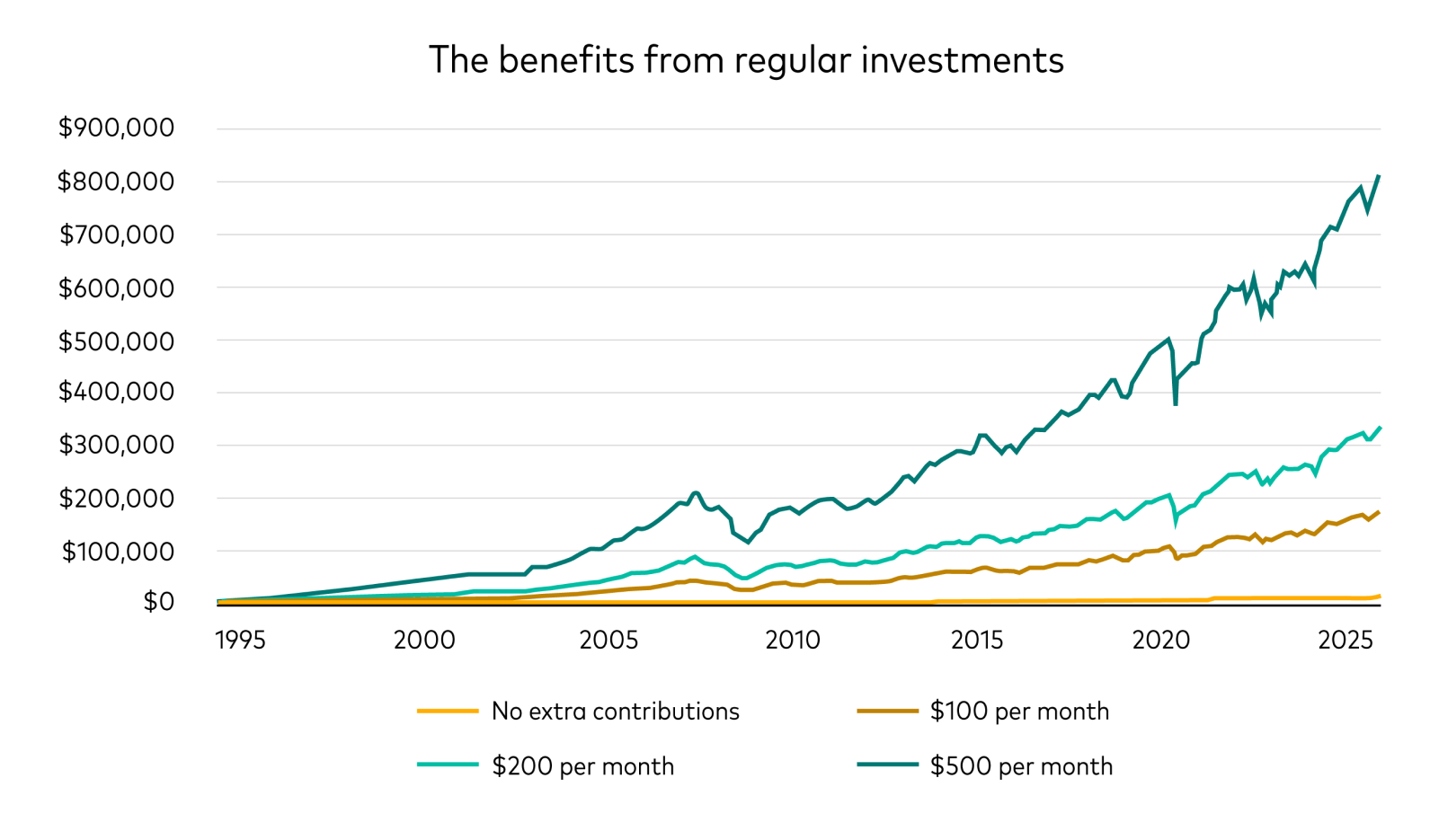
Source: Vanguard. Returns based on S&P/ASX All Ordinaries Total Return Index. Assumes the reinvestment of income distributions and does not take into consideration investment management fees, indirect costs, buy/sell spreads, or taxes. 

Past performance information is given for illustrative purposes only and should not be relied upon as, and is not, an indication of future performance. The performance of an index is not an exact representation of any particular investment as you cannot invest directly in an index.


It’s only when you compare the numbers in the table side by side that the full picture becomes much clearer.

An initial contribution amount combined with a regular investment savings strategy and the reinvestment of income distributions over time can deliver much higher long-term compound returns.


How regular contributions stacked up

Date

$0 contributions

$100 per month

$200 per month

$500 per month

1 July 1995

$1,000

$1,000

$1,000

$1,000

30 June 2000

$1,951

$10,409

$18,867

$44,240

30 June 2005

$3,062

$24,823

$46,583

$111,864

30 June 2010

$3,857

$37,164

$70,471

$170,391

30 June 2015

$6,034

$65,633

$125,232

$304,030

30 June 2020

$8,159

$95,545

$182,930

$445,087

30 June 2025

$14,379

$176,126

$337,873

$823,114

Source: Vanguard. Returns based on S&P/ASX All Ordinaries Total Return Index. Assumes the reinvestment of income distributions and does not take into consideration investment management fees, indirect costs, buy/sell spreads, or taxes. Values have been rounded down the nearest dollar.

Past performance information is given for illustrative purposes only and should not be relied upon as, and is not, an indication of future performance. The performance of an index is not an exact representation of any particular investment as you cannot invest directly in an index. 


In the examples used above, there would have already been a significant returns gap after just five years (by 2000) between investors who had not made regular investments versus others that had.

That gap would have kept widening over time. After 10 years investors who had followed a $100 per month regular investments strategy would have had a balance more than eight times greater than someone who had not made additional investments but had just reinvested their income distributions. By 2025 the balance differential would have widened to over 12 times.

On regular investments of $200 per month, the balance gap would have been more than 23 times by 2025, and based on regular investments of $500 per month it would have been close to 60 times.

Of course, the returns numbers would have been significantly higher based on a higher initial investment amount.

A $10,000 initial investment in July 1995 combined with $500 per month additional investments would have compounded to more than $950,000 by 30 June 2025.


Staying the course

The 30-year period between mid-1995 and mid-2025 has included nine Australian prime ministers and six U.S. presidents.

It has also included the Asian currency crisis in 1997, the dot.com crash in 2000, the Global Financial Crisis from 2007 into 2009, and the COVID-19 market crash in 2020.

To harness the full benefits of compounding over time, it’s important to have a disciplined, non-emotional approach to investing, irrespective of short-term events and volatility.

Making regular investments, and taking advantage of compounding returns, can really add up over the longer term.

They’re a powerful combination in helping you to focus on achieving your investment goals, ideally through an appropriately diversified portfolio, to give you the best chance of investment success.

Any investment is subject to investment and other known and unknown risks, including possible delays in repayment and loss of income and principal invested.


* The examples of an investment of $1,000 into S&P/ASX All Ordinaries Total Return Index on 1 July 1995 and the corresponding outcomes as of 30 June 2025 expressed in this article are based on the past performance of the S&P/ASX All Ordinaries Total Return Index. They assume the $1,000 is fully invested (and remains fully invested). The calculations assume no acquisition costs, fees or taxes, with all distributions reinvested. All results are displayed in nominal dollars i.e. inflation has not been taken into account. An actual investment would be subject to acquisition costs, fees and taxes.

Important Information

Vanguard Investments Australia Ltd (ABN 72 072 881 086 / AFS Licence 227263) (VIA) is the product issuer and operator of Vanguard Personal Investor and Vanguard ETFs and managed funds. Vanguard Super Pty Ltd (ABN 73 643 614 386 / AFS Licence 526270) (the Trustee) is the trustee and product issuer of Vanguard Super (ABN 27 923 449 966).

The Trustee has contracted with VIA to provide some services for Vanguard Super. Any general advice is provided by VIA. The Trustee and VIA are both wholly owned subsidiaries of The Vanguard Group, Inc (collectively, “Vanguard”).

We have not taken your objectives, financial situation or needs into account when preparing this article so it may not be applicable to the particular situation you are considering. You should consider your objectives, financial situation or needs, and the disclosure documents for the product before making any investment decision. Before you make any financial decision regarding the product, you should seek professional advice from a suitably qualified adviser. A copy of the Target Market Determinations (TMD) for Vanguard's financial products can be obtained on our website free of charge, which includes a description of who the financial product is appropriate for. You should refer to the TMD of the product before making any investment decisions. You can access our Investor Directed Portfolio Service (IDPS) Guide, Product Disclosure Statements (PDS), Prospectus and TMD at vanguard.com.au and Vanguard Super SaveSmart and TMD at vanguard.com.au/super or by calling 1300 655 101. Past performance information is given for illustrative purposes only and should not be relied upon as, and is not, an indication of future performance.

This article was prepared in good faith and we accept no liability for any errors or omissions.


Vanguard
18 August 2025
vanguard.com.au


Hot Issues

Kingston FP Logo

Kingston Financial Planning Kingston Financial Planning Pty Ltd (ABN 34 119 387 012) is an authorised representative of Charter Financial Planning Ltd ABN 35 002 976 294, Australian Financial Services Licence and Australian Credit Licence No. 234665
Principal Address: Level 6, 88 Phillip Street, Sydney NSW 2000

Building Wealth

When first entering the workforce, saving for retirement may not be something on your mind. It's common to aim for more short or medium-term goals like overseas travel, a new car, a deposit for a home or an investment in the stock market.

Building wealth also encompasses long-term strategies to help you make the most of your finances and the time you have in the workforce. Kingston Financial Planning Pty Ltd can work with you to look at all aspects of your lifestyle, your goals and your needs and develop strategies to optimise your earning potential.

Your wealth creation strategy could involve setting clear short, medium and long-term goals, putting together an easy-to-follow budget, directing any surplus funds to an investment portfolio, utilising tactics to minimise tax and putting strategies in place to protect yourself and your family.

Contact Us

Protecting Your Wealth

The consequences of not being able to work for six months, a year or more due to illness or injury can devastate your lifestyle and plans-and those of your family.

Have you considered what would happen to your family if the main breadwinner died? While nothing compensates for the loss of a loved one, it's easy to protect yourself and your family from the financial impact of the unexpected.

Term life cover

Term life insurance provides a lump sum payment for your family in the event of your death. The money can pay off the mortgage so your family can stay in the family home and meet other financial obligations. It can ensure that a difficult time is not made worse by unnecessary financial stress.

Total and permanent disability cover

Total and permanent disability insurance provides a lump sum payment if you suffer an illness or injury and are permanently unable to work. It can help you maintain your current lifestyle and pay any additional expenses that ongoing illness or injury can bring.

Trauma

Trauma insurance provides a lump sum payment if you suffer a major trauma such as cancer. It can make it easier for you to focus on your health and meet the costs of medical care and rehabilitation.

Income protection

Income protection insurance provides a regular payment in place of your income when you suffer an illness or injury and are temporarily unable to work. When you're out of action, day-to-day living costs don't stop. On top of them, the costs associated with overcoming an illness or injury need to be covered. Income protection cover can help maintain your lifestyle and take the pressure off until you're able to return to work.

Contact Us

Planning Your Retirement

As retirement nears, and you begin thinking about the retirement lifestyle you would like, your super comes more into focus.

Depending on when you plan to retire - at age 50, 55 or 60 - you may start thinking about putting extra money into super, maximising your investments, balancing risk and return, and looking at your wealth protection needs.

And as you think about winding down from the workforce, Kingston Financial Planning Pty Ltd will work with you to reduce the risk your super investments may be exposed to and protect the wealth you've worked hard to build.

For many, easing into part-time work and taking advantage of the government's transition-to-retirement rules is the natural way to move into the next stage of life. Whatever your plans, maximising your retirement savings is essential-and the way you structure your finances can have a direct impact on how much you end up with down the track.

Kingston Financial Planning Pty Ltd will help you work out the most effective way to make the most of your years in the workforce and draw an income from your super in retirement.

Contact Us

Estate Planning

Estate planning is a specialised area that can involve many financial complexities. While no one intentionally leaves behind complications for their loved ones, countless families are burdened with the difficulties of an out-of-date will.

You can make sure it's easy for your loved ones to receive what you leave behind. Kingston Financial Planning Pty Ltd will work in conjunction with you and your solicitor to ensure your assets will pass smoothly and tax-effectively to your loved ones.

Contact Us

Changing Jobs

Changing careers can be stressful. Whether you love your job or you've been thinking about finding a new one, being without work or having to change careers unexpectedly can be planned for.

You may find yourself considering career options you hadn't given serious thought to before: undertaking training, seeking further education, looking for part-time work or considering working for yourself and starting your own business.

Have you considered the financial and emotional implications of changing jobs? These can be overwhelming and can affect other areas of your life. There are many options to be considered to ensure you'll be satisfied with the changes you're making and that you receive the entitlements due to you when you leave your current job.

Making time to speak with us can give you the opportunity to explore the viability of your options, assess your future and ensure you stay on track to reach your goals.

Contact Us

Ageing Parents

As Australia's population continues to age, the proportion of people over 65 is rising. Many elderly people aim to remain independent and live in their own homes. But in some cases this isn't possible.

Fortunately, there are many options. Sometimes staying at home with regular support is possible and sometimes full-time in-home care is required. You may find that eventually you're faced with the difficult decision of helping your parents move to another residence where their wellbeing can be better supported.

Working with Kingston Financial Planning will ensure you're aware of the options available to your parents, that their needs are met and they do not unintentionally forego any financial entitlements.

We will look at the structure of your parents' assets to maximise Centrelink aged-care and health-care benefits to help their savings and support them to stay at home.

The impact of capital gains tax as a result of the sale of any assets may also be reduced or avoided altogether.

We can be there with you from the start to assist you with every aspect of exploring and managing your parents' options and needs. For example, by:

  • connecting you with care assessment teams and home support services
  • participating at family meetings to help ease the stress of challenging conversations during difficult times for your family
  • working with your accountant and lawyer to ensure the needs of your parents are well supported

Speak with us for the right advice and guidance.

Contact Us

Inheritance

Receiving an inheritance can leave you with mixed feelings. Dealing with the loss of a loved one, grief and other emotions can make it difficult to decide what to do. Sometimes during emotionally challenging times, the impact of tax and inheritance rules can be the last thing on your mind.

At such times, it can be comforting - and in your best interests - to speak with us. You can then go through the grieving process more freely with the assurance that tax and inheritance rules won't eat into your money unnecessarily.

Depending on the types of assets you inherit and the way any money is passed on to you, there can be issues to consider and manage in order to maximise the amount you receive.

Often when a loved one dies we can be reminded about the importance of planning for our own beneficiaries and ensuring everything is as uncomplicated for them as possible.

We can work with you and your accountant and lawyer to ensure you end up making the most of your inheritance, and can guide you in what you can do to ensure your loved ones are taken care of when you die.

Contact Us

Buying Property

Financial advice from Kingston Financial Planning can make a big difference in how quickly you can own that home or investment property you have been thinking about buying. How you structure your mortgage, and considering any existing loans and savings accounts you have-makes a big difference to your long-term financial success.

Assess your financial position with us and you can take years off the duration of your loan and own your property quicker.

Contact Us

Starting a Family

Welcoming a first, second or third child may be one of the most exciting and overwhelming times of your life. With a new child comes a new budget with many changes and a whole new life stage.

Financial decisions need to be made and it certainly pays to plan well ahead for such a significant time in life - especially if there's the chance your situation means changing from two incomes to one for any length of time. The cost of child care or an income reduction will have a financial impact throughout the child's lifetime and both or one parent may continue working and, depending on what's best for your family, the cost of child care while you're at work or a reduction in income will have a financial impact. The financial costs associated with having a baby can be surprising and related costs in raising the child need to be considered also.

When preparing for the arrival of your child, you may find yourself meeting the initial costs of furnishings for the nursery while you consider the day-to-day costs of looking after a baby. Some decide to buy another car while some may think about a larger home with a bigger backyard. The time also arrives when the options and costs for a child's education need to be considered.

Kingston Financial Planning can ensure these expenses are planned for, that your family and all you have worked hard to gain are protected and you can give your children the best start to life - regardless of what life brings.

Contact Us

Divorce

Whether you are married or in a de facto relationship, separating from your partner can be one of the most challenging times in your life. Current trends suggest that one couple in three will face the complicated emotional and financial issues of a separation or divorce.

When separating from your partner you'll need to review any joint investments, bank accounts, superannuation funds, personal insurance, health insurance, and possibly your tax arrangements. If you have children, you may need to address child maintenance arrangements too. In certain circumstances one or both parents may be entitled to temporary or long-term parenting payments from Centrelink.

By speaking with us you can be confident in your entitlements and options. Many people have benefited from our insights and assistance when negotiating with their partner.

The challenges can be complex and we can guide you through the financial implications of separation and help you prepare for the next chapter in your life.

Contact Us